Fragile Tamper-Evident Labels: The Third Piece of the Anti-Counterfeit Trifecta
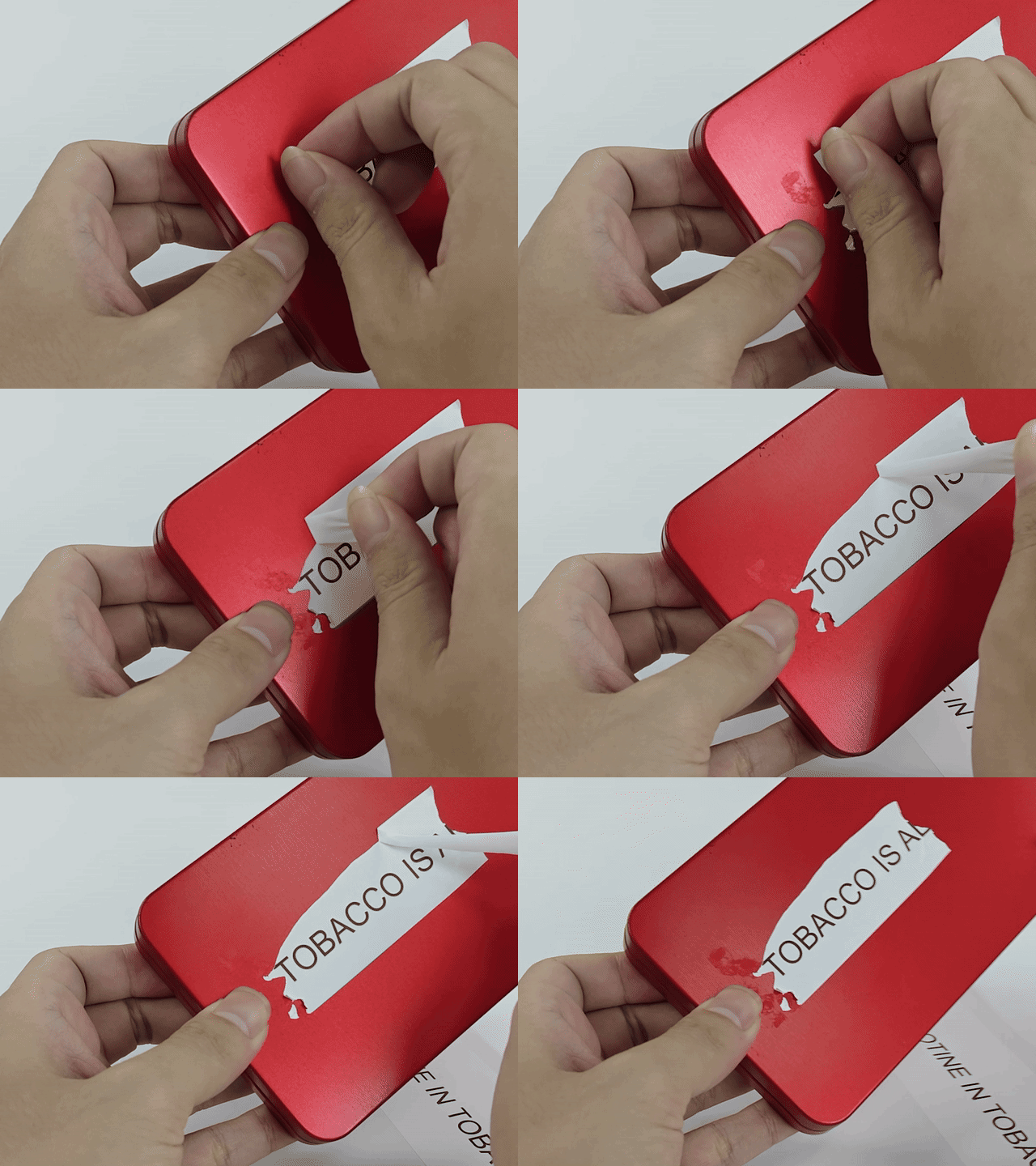
Pull the label and it shatters into pieces instead of peeling away — that is the whole logic of a fragile label in one line: once it’s opened, it shows. The animation above is a real fragile label being torn from a metal tin. This article is about the third piece of the anti-counterfeit trifecta: the fragile label — which, together with VOID transfer labels and laser-engraved labels, makes up the anti-counterfeit trifecta most common in label printing.
1. What a fragile label is
A fragile (brittle) label uses a face stock engineered to be extremely brittle, with almost no elongation. Try to lift it and the label fractures along the direction of force into multiple small pieces — it cannot be removed in one piece.
That “breaks rather than lifts” behaviour buys you three things:
- Cannot be lifted whole — transferring it onto a counterfeit and carrying on the scam is off the table
- Readable with the naked eye — a buyer or receiver sees the damage and is alerted immediately; no UV lamp, no loupe
- No residue message — a VOID label leaves the word VOID on the surface when lifted; a fragile label leaves fragments behind. Both logics have their place, depending on the job
2. Common face stocks and constructions
The heart of a fragile label is the brittle face stock. There are two substrate routes:
- Brittle paper (most common): specially treated glassine or brittle paper stock where the face material itself is highly brittle and tears easily. Representative grades include 3M 7812 / 7815 and tesa’s brittle series. Thin, low cost, good printability.
- Brittle film: BOPP or PET embrittled on the surface, or a film with a frangible layer laminated on top. Suited to jobs that need water or oil resistance — outdoor use, bathrooms, appliance housings.
What matters when specifying: the “break” comes from the brittle face stock, not the adhesive. So look first at how brittle the face stock is and at the balance between the adhesive’s initial tack and final bond — too aggressive an adhesive kills the brittle effect (you can’t get a corner up, you just tear the face stock), too weak and it won’t stay put.
3. Where they get used
Anywhere the rule is “if it’s been opened, it has to be obvious” — that is fragile label territory:
- Electronics warranty seals: over phone battery compartments, tablet ports, laptop screw holes. If the customer opens the unit themselves the warranty is void, and an authorised repair centre can spot a self-open from the damage alone.
- Asset numbering / asset management: on computers, servers, medical devices and office equipment as asset tags. Moving or reallocating means peeling, and peeling leaves evidence.
- High-value component sealing: genuine-part seals, bottle cap seals, tamper-evident closures — used together with single-use packaging.
- Utility meter seals: statutory seals on electricity, water and gas meters. Exact spec is customised to the local metrology institute’s requirements.
- Pharmaceutical / reagent bottle seals: stops product substitution, and stops a bottle being resealed after opening.
- Warranty validation: “void if removed” labels on the pack or on the product itself.
4. The anti-counterfeit trifecta: VOID + laser-engraved + fragile
A fragile label on its own already blocks most “peel and transfer” counterfeiting, but combined with the other two common technologies the coverage is much wider:
| Process | What it stops | Failure mode |
|---|---|---|
| VOID transfer label | Leaves the word VOID on the surface when lifted | Lift it and you have been found out |
| Laser-engraved label | Visual copying — a different pattern from different angles, pattern fully custom | Ordinary printing cannot reproduce it |
| Fragile label | Lifting and transferring the label whole | Tear it and it shatters — cannot be lifted whole |
Of the three, laser engraving is the most technically demanding layer: a laser cuts microstructures into the material so the pattern changes as the viewing angle changes, and the pattern is fully custom to the client — this is not an off-the-shelf generic laser film stuck on, each design is engraved from its own plate. That is exactly why it is the hardest to copy.
A few real samples make it clearer — many labels actually carry laser engraving and VOID on the same piece:
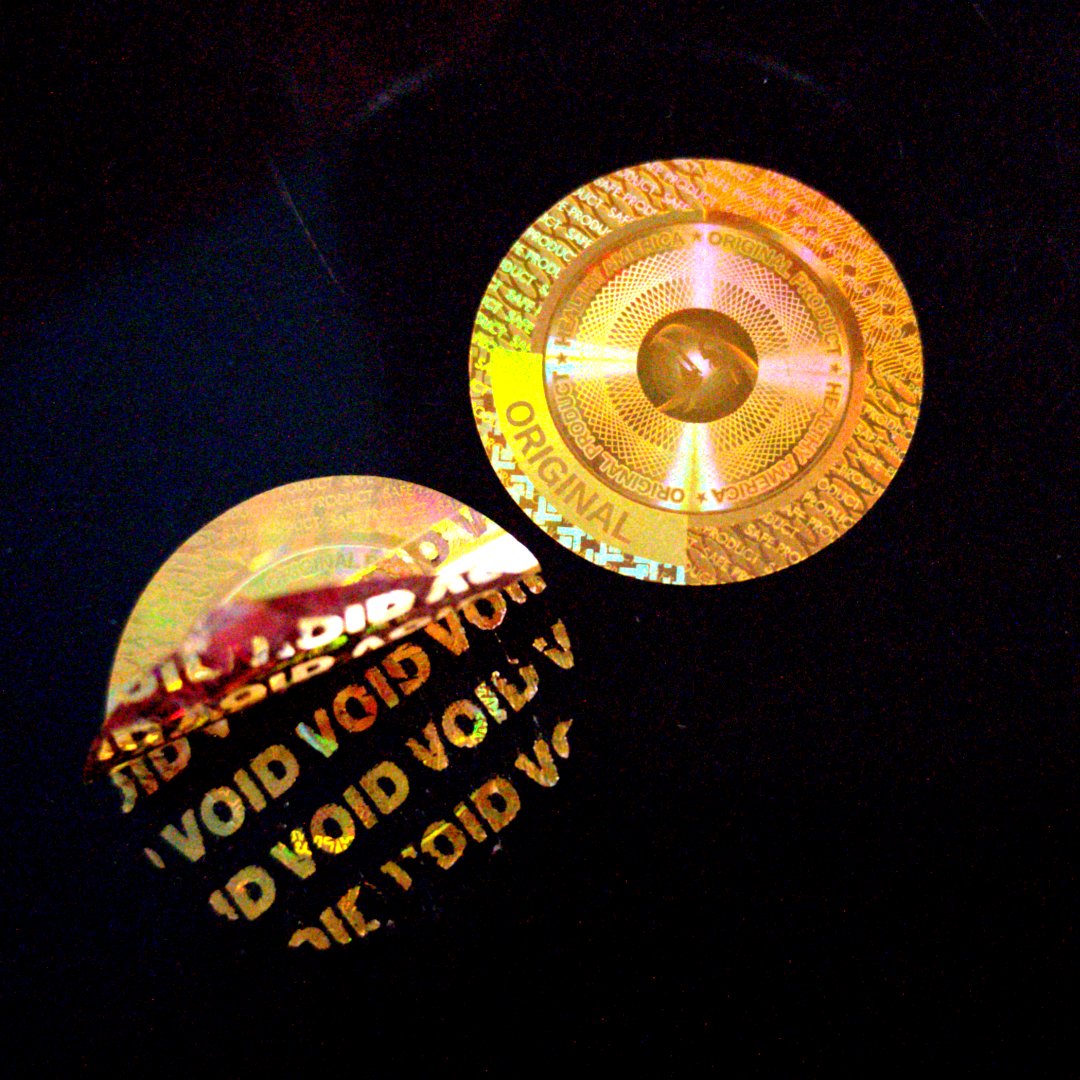
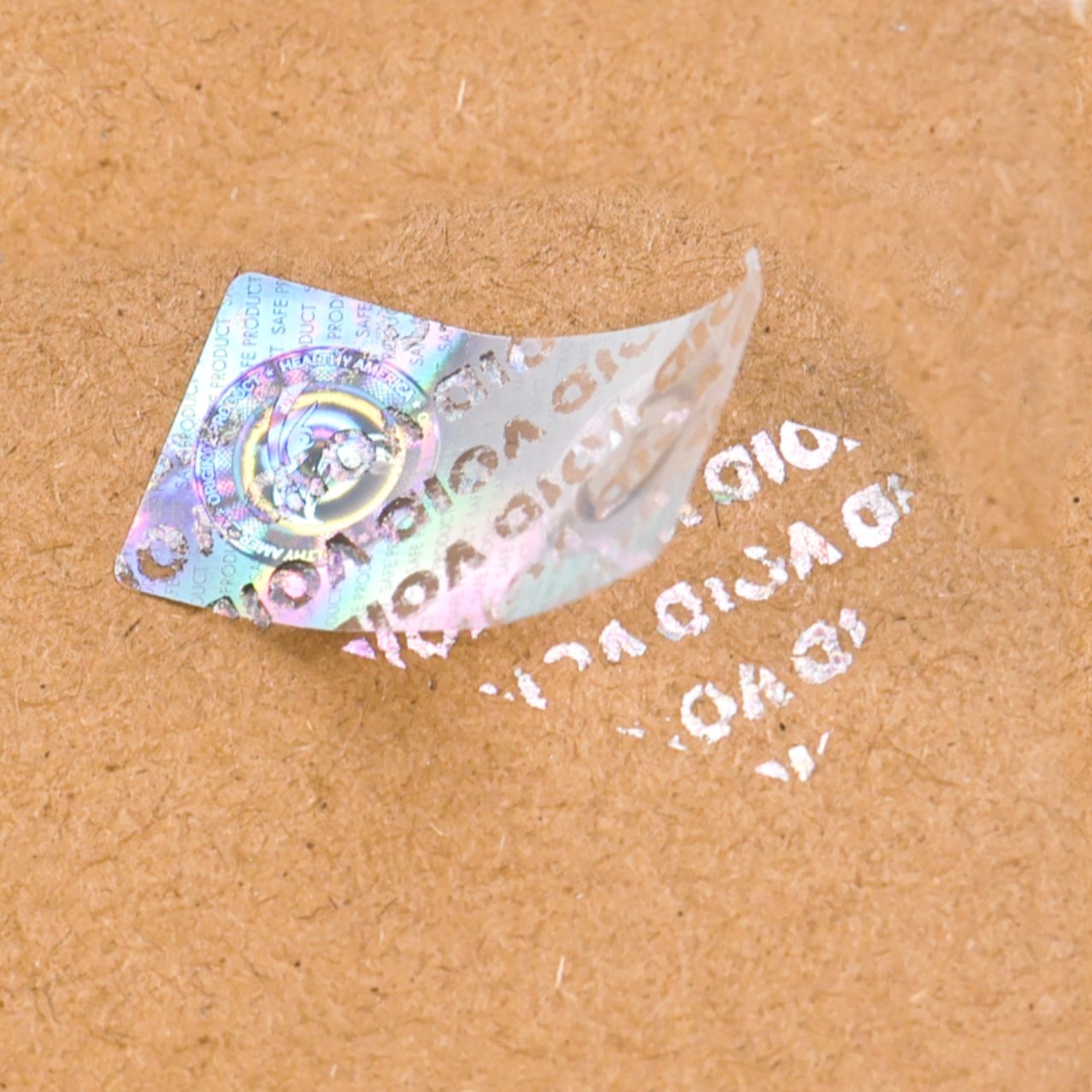
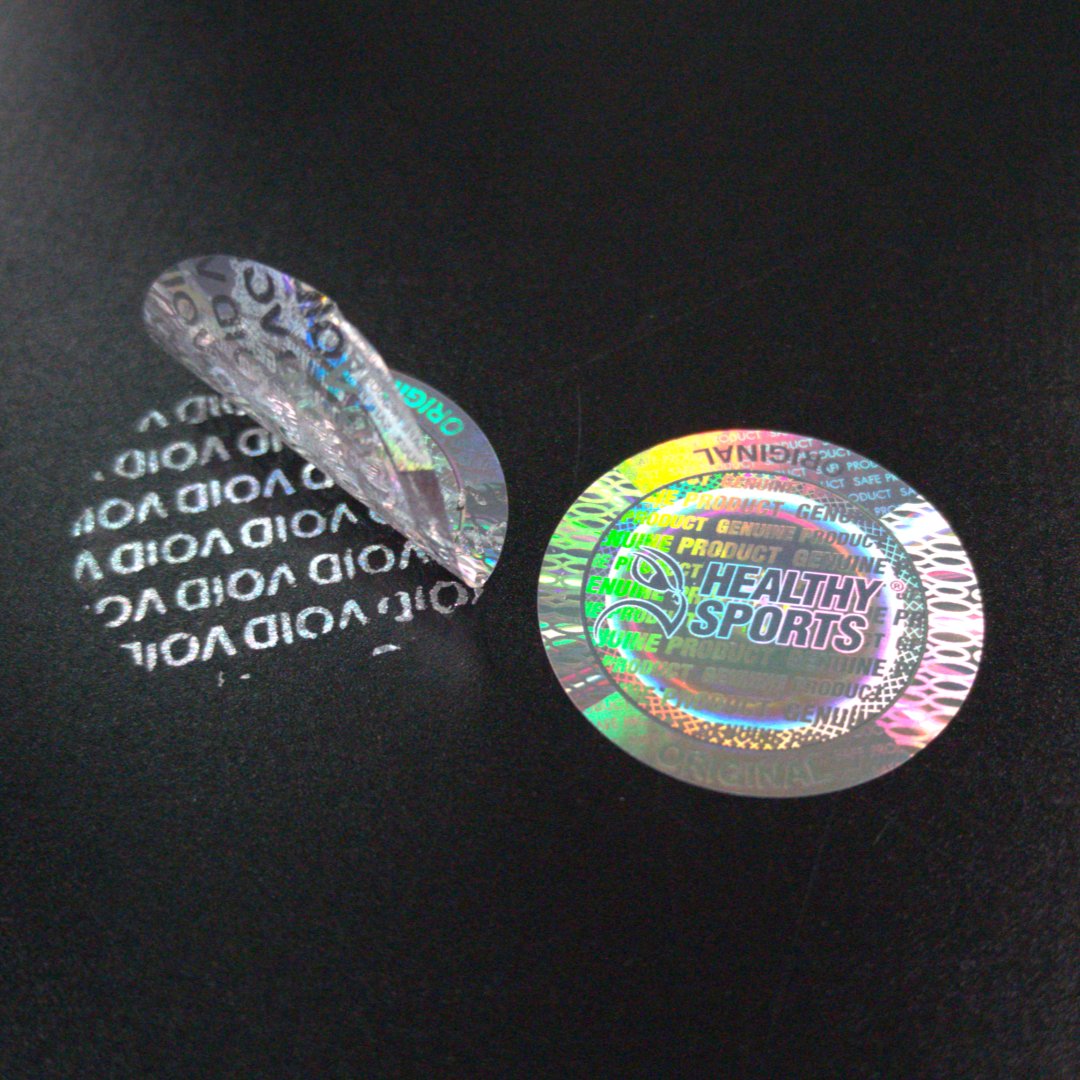
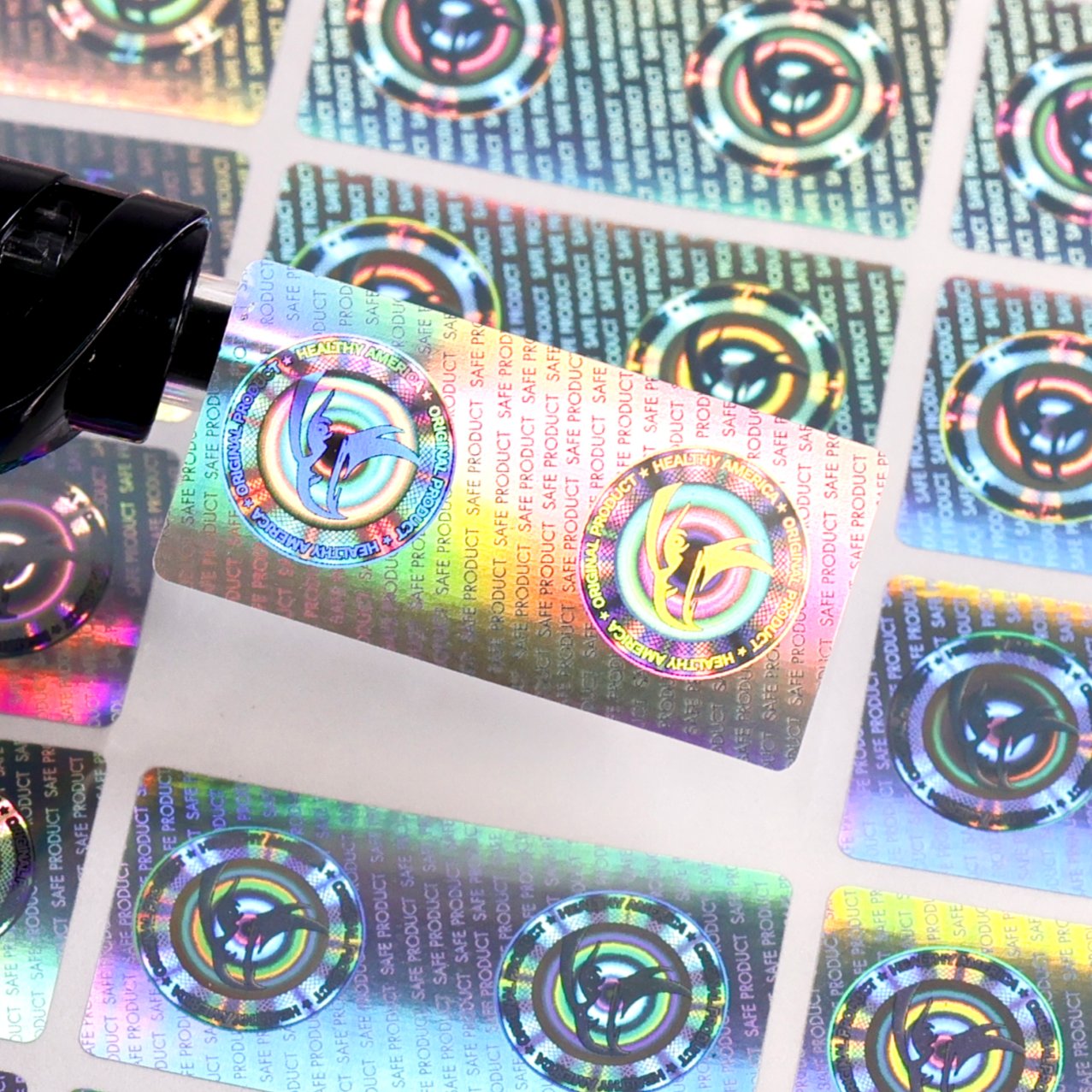
The logic of the three: each layer blocks one attack. VOID blocks “peeling it off quietly”, laser engraving blocks “printing a fake”, fragile blocks “forcing it off”. Clients pick the combination that matches their product and the cost of being attacked — you don’t always need all three, but whichever you need, you spec it.
5. What “shattering” actually looks like
In practice there are two behaviours:
- Paper-based: pick up a corner with a fingernail and pull, and the face stock splits all the way along the line of force — not one clean strip, but a dozen or more fingernail-sized fragments with jagged, completely irregular edges. Let go halfway and the fragments left behind are still stuck to the surface and cannot be picked off: the adhesive is still gripping the glass, plastic or metal, only the face stock itself has shattered. Thinking of using a heat gun to soften it and peel slowly? Hot air makes the stock more brittle and it shatters faster.
- Film-based: the film splits into several large pieces rather than crumbling to powder, and you can still trace the crack lines between them — but it still cannot be lifted whole.
Either way the end result is the same: you cannot lift the label off in one piece and move it to something else. That is the basis of the security.
How to test it yourself: apply a sample to a glass slide, press it down firmly, wait 24 hours for the adhesive to fully wet out, then pick at a corner with a fingernail. Whether it shatters, how it shatters, whether adhesive is left behind — you will see all three at once. This is also why we push clients to always order a production proof: a digital proof is printed on ordinary stock and will not show the real break.
6. Specs at a glance
| Item | Spec / options |
|---|---|
| Face stock | Brittle paper (3M 7812 / 7815, tesa, etc.) / brittle film (BOPP + embrittling coating) |
| Thickness | 50–80 μm (paper) / 50–100 μm (film) |
| Adhesive | Permanent (strong initial tack, stable final bond) / removable (low residue) |
| Printing | UV offset / screen / thermal transfer; spot + CMYK + spot UV + embossing (embossing on paper only, not recommended on film) |
| Finishing | Matte lamination / gloss lamination / spot UV |
| Die-cutting | Any shape, custom to artwork |
| MOQ | 1,000–3,000 pcs (smaller runs negotiable, unit cost higher) |
| Lead time | 7–12 working days including proof approval |
| Packaging | Cut singles or rolls (rolls for automatic applicators) |
| Typical uses | Warranty seals, asset tags, meter seals, anti-counterfeit combinations |
7. Common questions
How is a fragile label different from an ordinary one-time sticker?
An ordinary sticker lifts off whole and transfers easily. A fragile label shatters when you try. The difference is in the brittleness of the face stock — the adhesive formulation is broadly the same.
What surfaces do fragile labels work best on?
Glass, smooth plastics (ABS / PC / acrylic) and coated metals give the best results. Rough surfaces — corrugated board, frosted plastic, untreated wood — tend to fracture the face stock before it is even applied properly, so we do not recommend applying direct. If you must go onto a rough surface, a brittle film is the safer choice.
Can fragile labels be used outdoors?
Paper-based fragile stock is not waterproof and not weather resistant; outdoors, moisture accelerates embrittlement and the label falls off. For outdoor use, go with a brittle film plus a waterproof adhesive.
Can it be combined with a VOID transfer label?
Yes. VOID residue plus a brittle face stock gives you two layers: it shatters when torn, and it leaves a message when lifted. It does cost more. Suited to high-value products that need double protection — medical devices, expensive electronics.
How does sampling work?
For custom artwork we normally run a digital proof first (no brittleness treatment, artwork confirmation only), then a production proof on the actual brittle stock once you have signed off. Note: the real brittle behaviour can only be confirmed on the production proof — a digital proof will not show how the label actually breaks.
Do you take small runs?
Yes, but unit cost is higher on small orders, since setup is spread across fewer pieces. Below roughly 1,000 pcs it is worth checking the unit cost first.
Can fragile labels be any shape?
Yes — die-cutting supports any custom shape: circles, ovals, stars, custom outlines. Very narrow points or ultra-fine strokes do tend to break first during removal, though, so it is worth avoiding them in the artwork.
Pingback: Anti-Counterfeit Labels | Holographic, QR & VOID | DJB Print