
Sixteen years of running a label factory in Dongguan teaches you one thing fast: the label that looks right on the screen is rarely the label that survives on the shelf. Face stock, adhesive, printing method and finish each decide whether your label stays put, stays readable and stays legal. This guide walks through how we actually spec labels for real products — wine, spirits, cosmetics, supplements, chemicals, promotional stickers — and where most buying decisions go wrong.
Who this is for. Brand owners, packaging buyers and Amazon sellers who need to brief a label manufacturer without learning the whole trade. We cover materials, printing, durability, sizing, certification and how to talk to a China label manufacturer so you get the right label the first time.
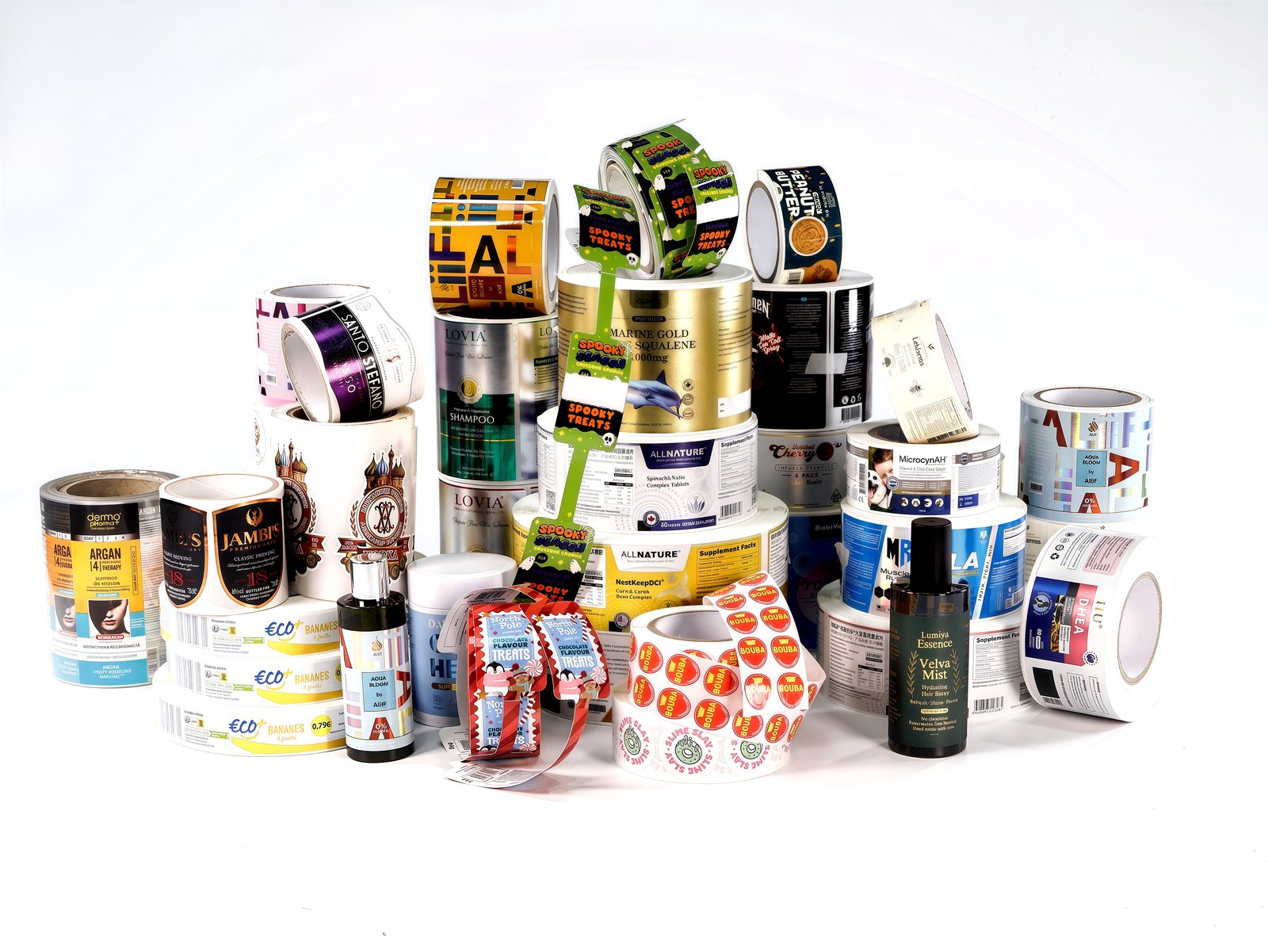
1. What a label actually is
A self-adhesive label — what the industry calls a pressure-sensitive label — is three layers you only ever see one of. The top is the face stock (the printed surface). Underneath is the adhesive, and under that a release liner (usually glassine or PET) you peel away before application. The magic is that the adhesive is already live: press it on and it sticks. No water, no heat, no solvent.
Most failures we see on returned jobs are not printing problems. They are face-stock or adhesive problems — the label was specified for an office, not for a freezer, a shower or a warehouse in July. The rest of this guide is about getting those two layers right.
2. Face stock materials — and when each one earns its place
The face stock is where BOPP vs PET becomes the first real decision. Both are plastic films, both are waterproof, but they behave differently:
- BOPP (biaxially oriented polypropylene) is our default for most product labels. It is squeezeable, resists moisture and oils, and takes foil, screen and UV finishes cleanly. Clear BOPP gives you the “no-label look” on a cosmetic or supplement bottle.
- PET (polyester) is stiffer and more dimensionally stable. It survives higher heat, harsh chemicals and aggressive handling — that is why we reach for PET on automotive fluids, industrial chemicals and products that sit in hot trucks.
Beyond the two films, the materials we actually run include:
- PVC / vinyl labels — flexible and conformable, good for curved surfaces and outdoor stickers, but heavier and less eco-friendly than BOPP/PET.
- Thermal paper / thermal transfer — the receipt-and-logistics workhorse. Direct thermal needs no ribbon; thermal transfer uses a ribbon for longer life. Great for shipping and warehouse, wrong for a premium bottle.
- Static cling — no adhesive at all, clings by static to glass and smooth plastic. Ideal for window promotions and reusable price tags.
- Writable / laser / inkjet labels — face stocks coated to take a pen, a laser printer or an inkjet print. Used for asset tags, sample jars and in-house labelling.
- Egg-shell / security paper — a frangible paper that tears if you try to remove it. We use it on warranty seals and single-use closures.
- Destructible / tamper-proof labels — fragment on removal so you can see the pack was opened. A cousin of our VOID tamper-evident range.
| Face stock | Best for | Avoid if |
|---|---|---|
| BOPP (clear / white) | Cosmetics, supplements, food, promotional stickers | You need high heat or solvent resistance |
| PET | Automotive, chemical, heat-exposed products | Budget is tight (costs more than BOPP) |
| PVC / vinyl | Curved surfaces, outdoor stickers | You want a recyclable material |
| Thermal / thermal transfer | Shipping, warehousing, waybills | The label is the brand-facing surface |
| Static cling | Window promos, reusable tags | The surface is not smooth glass/plastic |
| Egg-shell / destructible | Warranty seals, single-use closures | You need a clean removable label |
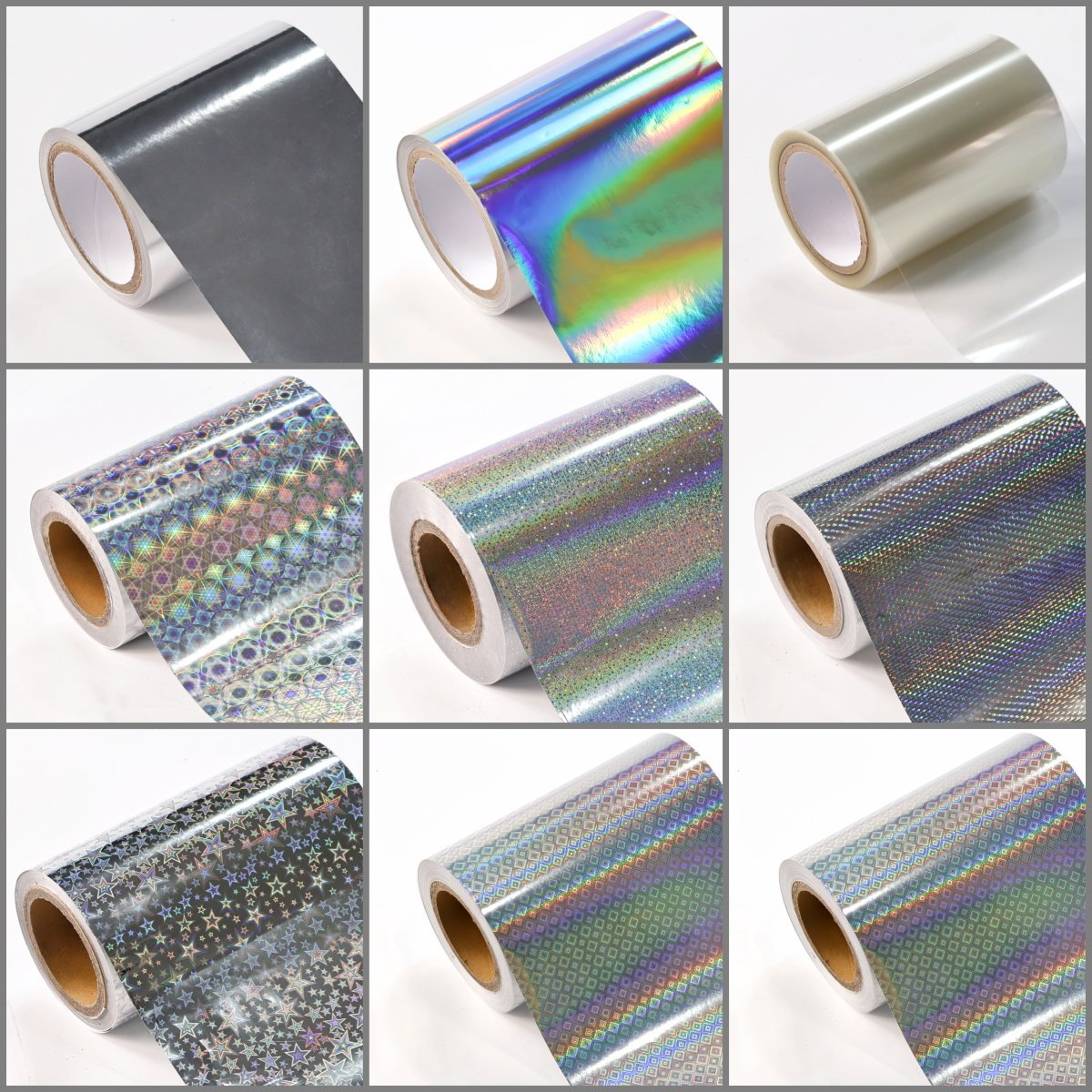
3. Finish: glossy vs matte, and lamination vs varnish
The finish is what your customer’s finger feels first. Glossy vs matte is the obvious choice: gloss reads “fresh and premium” on a beverage; matte reads “understated and tactile” on a skincare jar. Underneath both sit two protection methods:
- Lamination lays a film (gloss, matte or soft-touch) over the print. It is the toughest protection against scuffing, water and oil, and soft-touch lamination is what gives luxury cosmetics that velvet feel.
- Varnish is a liquid coating (often UV-cured). Spot UV, for example, is a varnish that highlights one area. It is thinner than lamination and cheaper, but less resistant to abrasion.
- Aqueous coating is a water-based, low-VOC finish — a greener middle ground for high-volume runs that still need a sealed surface.
Common mistake. Specifying a gloss laminate on a label that will live in a shower, then wondering why it eventually lifts at the edge. Lamination protects the print; it does not replace the right adhesive. Finish and adhesive are two different decisions — pick both.
4. Printing methods: digital, flexo, offset and how they reach the web
How a label is printed decides its cost curve and its floor on quality:
- Digital — no plates, fast setup, economical from one label up to short runs. Perfect for prototypes and small-batch SKUs.
- Flexographic (flexo) — plate-based, fast and cheap at volume, the backbone of most product-label production.
- Offset printing — photographic detail and colour consistency on long paper and film runs where registration must be exact.
Equally important is the form it ships in. Roll-to-roll (web) printing delivers labels on a roll for automatic applicators — essential if your line runs hundreds of bottles a minute. Sheet-fed printing delivers cut sheets for hand application, smaller runs and laser/inkjet-compatible stocks. Match the format to your packing line, not just to the price.
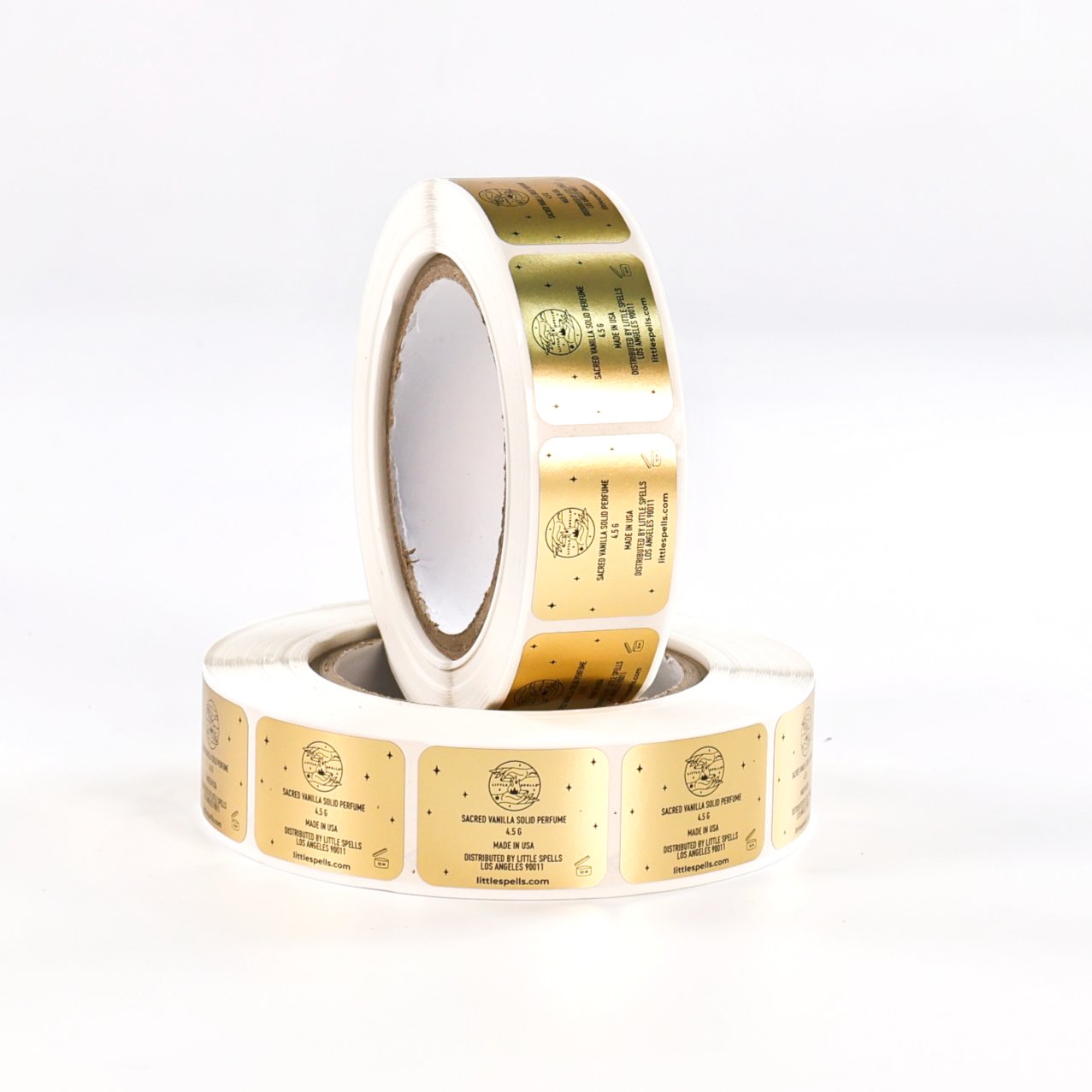
5. Durability: waterproof, heat-resistant, outdoor and dishwasher safe
This is where specs stop being theory. A few real scenes:
- Waterproof vs water-resistant. Waterproof means the face stock and adhesive shrug off immersion (BOPP/PET + the right adhesive). Water-resistant means it survives splashes and condensation but not a soak. Know which your product needs before you brief the factory.
- Heat-resistant. Labels near engines, in hot-fill lines or in a warehouse roof space in summer need PET or a heat-stable film — standard paper will curl and the ink will ghost.
- Weatherproof / outdoor. Garden chemicals, pool care and outdoor equipment need UV-stable inks and an adhesive that holds through freeze-thaw cycles.
- Dishwasher safe. Reusable drinkware, branded containers and premium jars need a laminated film label with an aggressive permanent adhesive, or the corners peel after one cycle.
Factory note. We test problem labels in the environment they will actually live in — freezer overnight, then a steam test, then a scratch pass — before we sign off. If a buyer skips that step, the failure shows up at the retailer, not at our door.
6. Sizing, shape and the roll core
A label size and shape guide sounds basic until a 38 mm label will not clear the cap, or a die shape jams the applicator. Three things to lock early:
- Minimum and maximum size. Very small labels (under ~10 mm) lose legibility; very large ones need a bigger die and a wider web. Tell us the extreme ends of your range.
- Shape and radius. Sharp internal corners catch and tear on high-speed lines. We soften dies for a reason.
- Core size and roll width. Automatic applicators expect a specific core (commonly 3-inch) and roll orientation. Get this wrong and the roll will not mount — a costly surprise at packing time.
7. Certifications that actually matter
Depending on the market, the label itself may need to carry or support certification:
- FDA compliance for direct and indirect food contact, and for cosmetics claimed safe on skin.
- ISO quality systems at the factory (we run to ISO controls on coating and printing).
- GHS hazard labelling for chemicals — pictograms, signal words and supplier information in the right layout.
If your product ships to the EU or US, ask for the certs up front. Retrofitting compliance after a batch is printed is expensive.
8. Customization without the complexity
Most of what buyers want is standard for us: personalized labels with your artwork, custom clear stickers for the no-label look, custom waterproof labels for bath and kitchen, and label templates we set up so your team can drop in new SKUs without a redesign each time. Low minimums mean you can prototype a label the same week you sketch it.
9. Sourcing from a label manufacturer
When you are ready to buy, you are not just comparing price — you are choosing a partner. A good label supplier or sticker manufacturer will spec the material for you, not just print what you drew. Working with a China label manufacturer gives you scale and speed; for a made-in-China label program the mature local supply chain keeps both lead time and unit cost down. Wholesale and bulk pricing only pays off if the first article is right, so send a physical sample of your bottle or jar wherever you can. We also support private label and OEM programs, and we handle online label printing orders end to end. If you are a label broker or reseller, talk to us about trade terms — we already supply several.
What to send on the first brief. (1) Substrate the label sticks to. (2) Environment — temperature, moisture, oil, sunlight. (3) Application method — hand or automatic, roll or sheet. (4) Quantity and reorder rhythm. Four lines save two rounds of sampling.
Specs at a glance
| Decision | Our default | Upgrade when |
|---|---|---|
| Film | White / clear BOPP | Heat or solvent exposure → PET |
| Finish | Gloss or matte lamination | Need eco + sealed → aqueous |
| Flexo at volume, digital for short runs | Photo detail → offset | |
| Form | Roll for auto-apply | Hand apply → sheet-fed |
| Adhesive | Water-based | Freezer / oil / outdoor → oil-based |
Common questions
How do you apply a label so it stays?
Apply to a clean, dry surface at room temperature. Press from the centre out to push air bubbles to the edge, and let the adhesive dwell 24 hours before it sees water or stress. On a curved bottle, start at the centre of the broad face and roll the label around the curve.
How do you remove a label without damage?
For removable adhesives, peel slowly at a low angle. For a permanent label, warm it with a hairdryer to soften the adhesive, then lift an edge with a plastic scraper and wipe residue with alcohol. Egg-shell and destructible stocks are designed to break rather than come off whole — that is the point.