
Custom Tear-Line Labels: Tear Exactly Where You Want, Stay Put Everywhere Else
A coupon you can’t peel off, a sample sachet you need scissors for, a warranty card glued to the product that nobody bothers to pull — these look like small things, but they quietly kill conversion. The tear line (tear seam / perforation) solves one sentence: “tear where you should, stay intact where you shouldn’t.” This article explains what it is, where it fits, and exactly how we run it on the production floor.
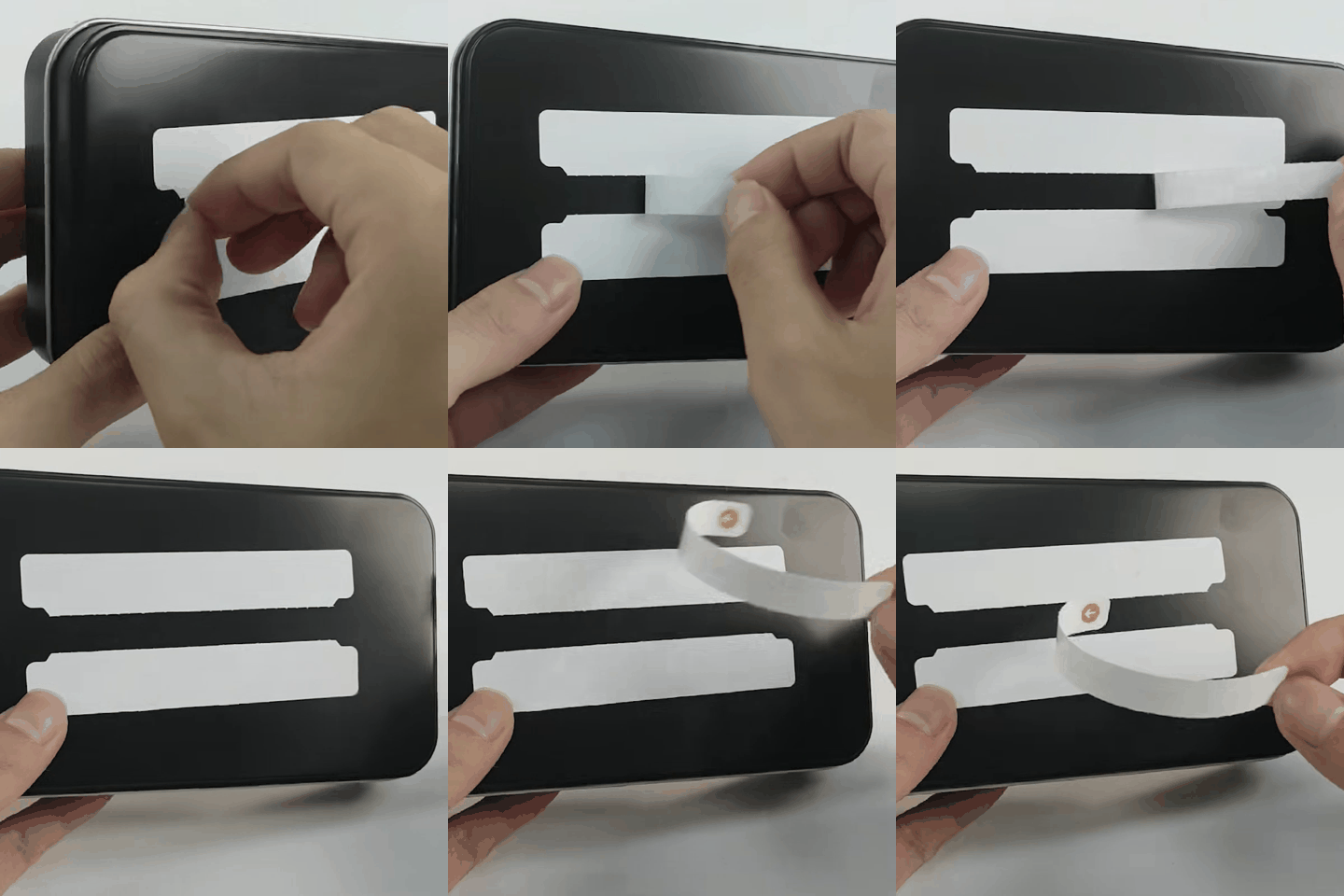
1. What a tear line actually is
Plainly: it’s a row of extremely fine pinholes. Pull gently along that line and the material splits cleanly at the holes; pull off-line and the label stays one piece.
- Tear seam: a dashed line that shows the direction to tear, like the pre-fold on a box flap — it tells you “tear from here.”
- Perforation: a row of regular small holes, like a postage stamp. Beyond function, it decorates — many hang tags, greeting cards and premium packs get their texture from it.
- Difference from die-cutting: die-cutting cuts out the outline of the label; perforation punches a row of holes in the material without cutting through. They’re often paired — die-cut the shape first, then perforate where it needs to tear.
2. Why you need it: real scenarios
Anywhere “part must tear away, part must stay” is where the tear line earns its keep:
- On-pack coupon / rebate: a row of tear-line perforations on the coupon, the customer pulls it off, the main label stays intact. Not being able to tear it off is the single biggest turn-off.
- Sample / sachet tear notch: a tear opening on sample packs and trial sizes — hand-tear, no scissors.
- Multi-layer “peel to reveal” label: the top layer tears along the line to reveal the VOID anti-counterfeit layer, promo code, or a second language. This is where perforation meets anti-counterfeit most tightly.
- Warranty / guarantee card: tear off along the line to keep, main label stays on the product.
- Hang tag / swing ticket: thread the string through the perforation; pull the string and the tag doesn’t break.
- Roll subdivision: a roll of material split into sheets by perforation for easy one-by-one manual pickup.
- Resealable: stop at the tear line; the remaining seal function still works.

3. How we run it on the floor: one non-negotiable red line
The tear-line process isn’t complex, but doing it clean takes care:
- Rotary or platen perforation wheel: a row of pins presses micro-holes into the face stock. Hole pitch and depth are tuned to your spec.
- Red line (same as die-cutting): never cut through the liner, never leave burrs. Punch through the release liner and the label falls off early; leave burrs and it tears unevenly and feels sharp. We inspect this on every shipment.
- Paper base: cleanest hole walls, cleanest tear, the most common and most stable choice.
- Film base (BOPP / PET): film’s resilience means a dull wheel or wrong settings make the holes spring back — the film re-seals itself and won’t tear clean. So film perforation needs a sharper wheel, heated assist when needed; we tune the machine per material.
- Kiss-cut: cut only to the release layer, not through the liner. Often paired with perforation for a “dashed line + kiss-cut” combo — tears open but never breaks the liner.
A common pitfall: some use ordinary punching holes as perforation. A punched hole goes all the way through; a perforation does not. They look alike but tear completely differently. Perforation is “connected but not cut through” — it guides the tear with micro-holes, not with holes.
4. How to choose material and structure
- Paper base (art paper / synthetic paper): cleanest tear, lowest cost, the default for most scenarios.
- Film base (matte PP / glossy PP / PET): water- and oil-resistant, for outdoor, bathroom, appliance housings. The trade-off is managing spring-back; machine settings are pickier.
- Tear seam vs perforation: the former is a single dashed guide line; the latter is a decorative + functional row of holes. Both can coexist on one label.
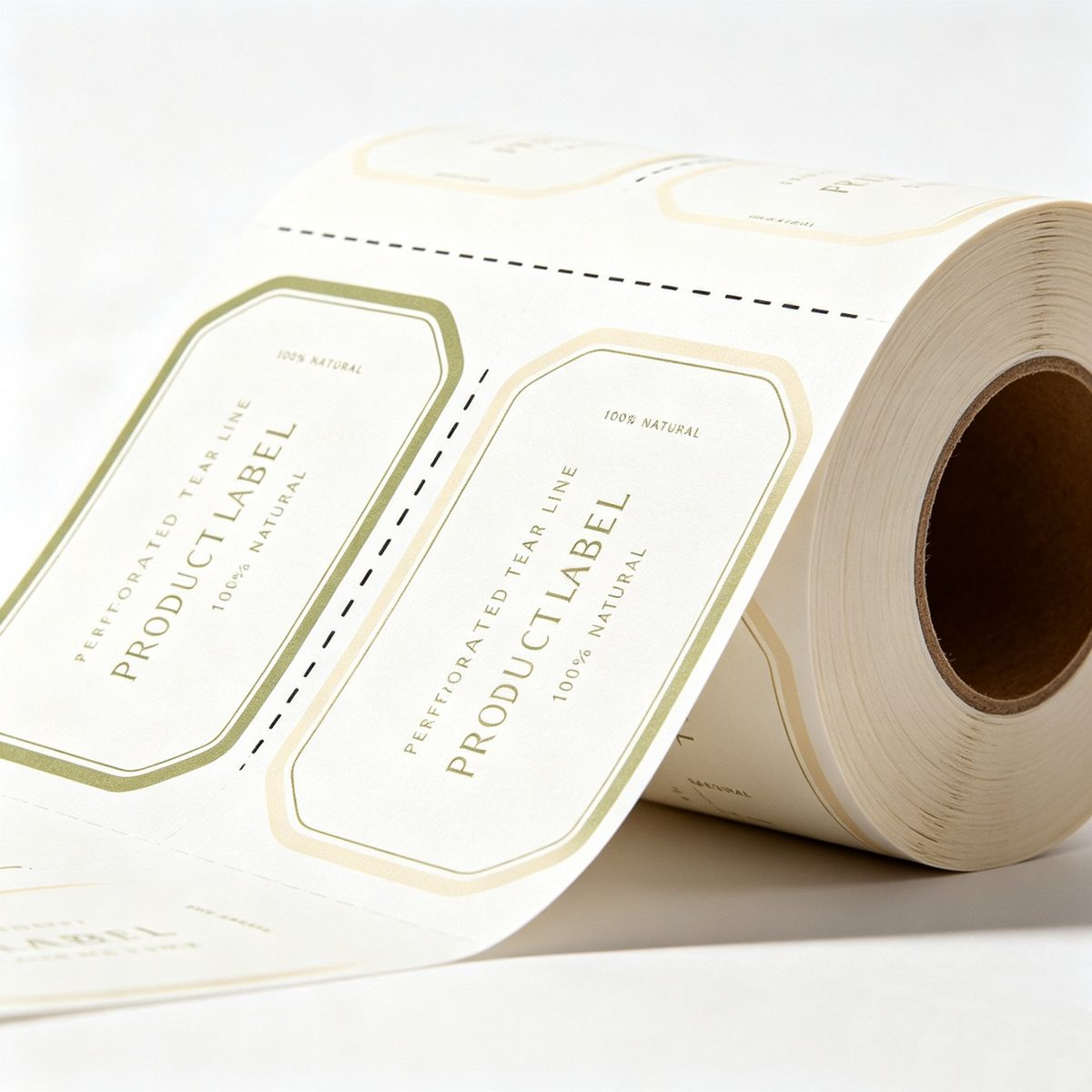
5. What processes it pairs with
A tear line is itself a “functional base process” — it shines when you stack other processes on top:
Multi-layer + tear line (peel to reveal VOID / code)
Hot foil + tear line
Variable code / serial number + tear line
Emboss + tear line
The most common combo is multi-layer + tear line + VOID: tear the top layer, the VOID residue text shows on the bottom — both convenient structure and anti-counterfeit. Used most on supplements, electronics and high-value accessories.
6. Specs at a glance
| Item | Spec / Options |
|---|---|
| Face stock | Art paper / synthetic paper / matte PP / glossy PP / PET |
| Adhesive | Permanent / removable |
| Tear-line form | Tear seam (single line) / perforation row / kiss-cut dashed line |
| Hole pitch | Custom (common 2–5mm) |
| Combinable processes | Die-cut / multi-layer / hot foil / variable code / emboss / VOID |
| MOQ | 500 pcs (special combos quoted separately) |
| Lead time | 5–7 working days (incl. proof confirmation) |
| Sampling | Free digital proof in 24 hours |
| Shipping | Direct from Dongguan factory, 80+ countries |
7. Common questions
What’s the difference between a tear line and die-cutting?
Die-cutting cuts the outline of the label; perforation punches a row of holes that don’t cut through to guide the tear. One defines shape, the other defines the tear point — often used together.
Does film base spring back on tear lines?
Yes. Film’s resilience makes holes re-seal and tear dirty. We use a sharper wheel, heated assist when needed, and tune per material.
Can it pair with VOID multi-layer?
Yes, and it’s common. Tear the top layer along the line, the VOID residue shows underneath — convenient and anti-counterfeit, widely used on supplements and electronics.
Will the perforation cut through the liner?
Normally no — it’s our shipment red line. If it ever does, we redo it. You can check on receipt: tear and see if the release liner breaks.
What’s the MOQ?
500 pcs. Special combos (e.g. multi-layer + VOID + tear line) cost a bit more per piece; quoted per artwork.
Can I do die-cut shape + tear line?
Yes. Die-cut any shape, then perforate where it needs to tear — the two processes don’t conflict.